The History of Freckleton
)
Freckleton village is situated on the south Fylde near the junction of the Dow and Douglas rivers north of the Ribble. It existed in Roman times and the lake or pool here was probably used as a port to supply the fort at Kirkham a few miles north.What little remains of the Freckleton quay can be seen at low tide between the boat yard and Naze point at the end of the headland.
The village is mentioned in The Domesday Book, although the name is apparently spelt FRECKULTON (or FRECHELTON depending on which reference work you read). Various other names have been recorded through the years such as FREQUELTON, FREKELTON and FREKILTON before becoming known by its current name. A suprise to many is that Freckleton was in Yorkshire at that time! You can read more about the history of Yorkshire and Lancashire <Here>
Freckleton water mill, built in the 14th century, provided milled corn for the local agricultural community. It was demolished in the 1960’s.
In the 1800’s Freckleton became an industrial village serving the ship building industry. Factories were established to make sail cloth and ropes. Most have now been demolished but some remains still exist, mostly in road names.
At one time there were seven public houses in the village. The Ship Inn, The Coach and Horses and The Plough Hotel are still serving food and drink today. The Mariners' Arms, Lamaleach Arms, the Bush Inn and the Cyclists' Arms are no longer in business.
Prior to 1920 when the current Preston road was built, Freckleton controlled the access to Lytham and St Annes via the toll road running across the marsh. The toll house still exists and can be seen on the left when approaching Freckleton from Preston. The raised ground that marks the route of the toll road can still be made out running across the marsh at the bottom end of Preston Old Road / Lower Lane.
During WW2 the Americans were based at Warton Aerodrome. The disaster that occurred when an aircraft crashed into the village school is still discussed today. The Freckleton Memorial Playing Fields, dedicated to the memory of those who died on the 23th August 1944, were reopened in April 1986.
Modern day Freckleton serves as a dormitory for employees of nearby BAE Systems at Warton and is a thriving community with a wide range of shops and businesses. The village still has a large dependency on agriculture.
Club Day 1969 & 1972
Colin Robb has very kindly supplied some pictures of Club Day from 1969 and 1972. You can find them <here>
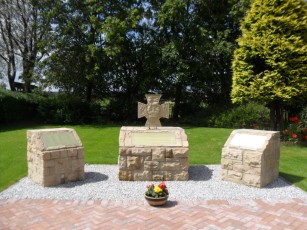
The Samuel Frickleton Memorial - Slamannan
The Freckleton History Group meet at Freckleton Library on the last Wednesday of the month from 1.30 to 3.00 pm.
)
Reference books
'The History of Freckleton' , by Peter Shakeshaft, ISBN 1-85936-084-X published by Carnegie Publishing Ltd.
'Voices of Freckleton', by Peter Shakeshaft, ISBN 978-1-5272-6733-6 <Voices of Freckleton flyer>
'The Freckleton, England, Air Disaster' by James R. Hedtke, ISBN: 978-0-7864-7841-5 published by McFarland.
'Warton and Freckleton' by Peter Benson, Lundy Publishing
'Freckleton Postcards', out of print
'Freckleton Recalled', out of print
'Reminiscences of Freckleton', out of print
The Francis Frith web site has a number of old pictures and maps of Freckleton.
We have a number of old pictures in our Picture Gallery.
Freckleton Tragedy 1944
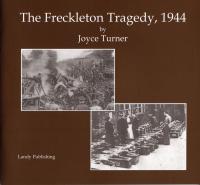 The book
chronicles what happened on that terrible day using mainly survivor's
memories and eyewitness accounts. Written by village librarian
Joyce Turner the book is available from the library priced £6.
All proceeds from the sale of the book will benefit the children
of Freckleton. The book
chronicles what happened on that terrible day using mainly survivor's
memories and eyewitness accounts. Written by village librarian
Joyce Turner the book is available from the library priced £6.
All proceeds from the sale of the book will benefit the children
of Freckleton. |
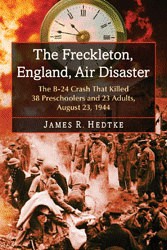 Publishers statement "In a compelling account of sorrow, loss, hope and finally rebirth, the book looks at the history of the village, the establishment of the base at Warton, the crash, the funeral of the 61 victims, the official British inquest and the American investigation into the cause of the crash. The lives of the survivors, the servicemen and the villagers are followed through 2012." Publishers statement "In a compelling account of sorrow, loss, hope and finally rebirth, the book looks at the history of the village, the establishment of the base at Warton, the crash, the funeral of the 61 victims, the official British inquest and the American investigation into the cause of the crash. The lives of the survivors, the servicemen and the villagers are followed through 2012." |
August 23rd 1944 is remembered as the worst day in the history of Freckleton.
Tragedy hit when an American B-24 Bomber crashed on Holy Trinity School and a nearby cafe killing 61 people. Among the dead were 38 children and two teachers, the proprietors and staff of the cafe and a number of American and British servicemen including the pilot and crew of the plane.
<WWII History Magazine article>
<Lancashire Aircraft Investigation Team>
<The Independant 75th Anniversary Article>
Frickleton Family
As far as we know there are no members of the Freckleton or Frickleton family still living in Freckleton.
Robert Frickleton Jack has kindly provided us with a bit of history about the 'Fighting Frickletons' which you can read <here>
The Story of Freckleton through 2000 years
E. C. Freckleton of Bolton, Ontario, Canada has researched his family history and provided his findings to us. You can find it <here>.
Old Photos of Freckleton
Mike Rigg has kindly provided us with some old photos and postcards
have been added to our gallery.
If anyone else has any old photos taken in and around Freckleton
that they would like to share with us then please
send an email to